
What Is a Micropipette?
A micropipette transfers liquid in very small, controlled volumes. The selected volume is normally shown on a display or set using an adjustment mechanism. The user fits a compatible disposable tip, aspirates liquid into the tip, and dispenses it into a tube, vial, well plate, or other laboratory vessel.
Micropipettes are not ordinary measuring devices. Their delivered volume depends on the instrument, the fitted tip, the liquid, the selected volume, the condition of internal seals, and the user’s technique. For this reason, the correct volume range and compatible tip are as important as the product itself.
Introduction
A micropipette is a precision laboratory instrument used to measure, aspirate, and dispense small volumes of liquid. It is designed for microlitre work, where even a small handling error can affect a test result, sample concentration, or assay performance. Micropipettes are used every day in research laboratories, diagnostic centres, pharmaceutical quality-control laboratories, colleges, microbiology facilities, and molecular biology workflows.
This guide explains what a micropipette is, the main parts shown in a labelled diagram, the types and volume sizes available, common laboratory uses, the role of disposable tips, and the practical checks that help users choose and use an instrument correctly. It is an educational guide; always follow the operating instructions and performance limits supplied with the specific micropipette model in use.
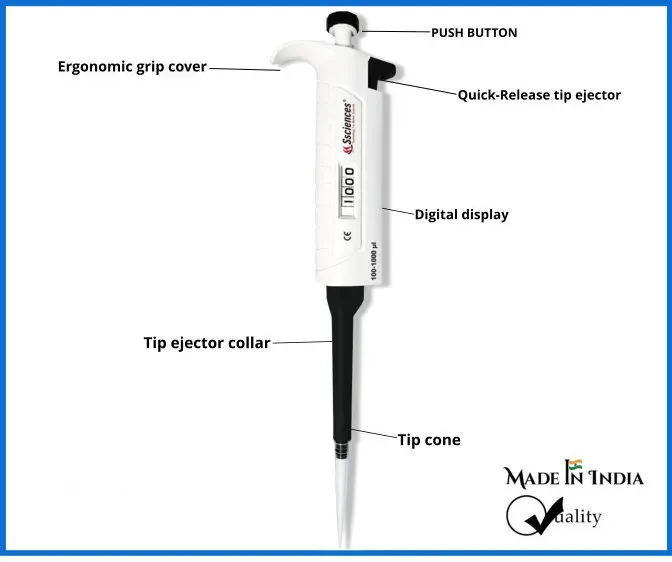
Micropipette Diagram and Main Parts (
What Is a Micropipette?)
The diagram shows the parts a user commonly handles. Internal parts, especially the piston and seals, should not be dismantled or adjusted unless the manufacturer’s procedure and trained service support specifically permit it.
| Part | Function and practical importance |
| Plunger button | Controls aspiration and dispensing. Many manual micropipettes use a first stop for normal dispensing and a second stop to expel the remaining liquid from the tip. |
| Volume adjustment control | Sets the target volume on variable-volume models. Set only within the stated range for that model. |
| Volume display | Shows the selected setting. Read the display according to the manufacturer’s markings because the decimal position can differ between ranges. |
| Finger rest or hook | Supports a stable grip and helps reduce hand strain during repeated pipetting. |
| Tip ejector | Allows the used tip to be removed without touching it. This supports safer and cleaner routine work. |
| Tip cone | The lower fitting point where a compatible disposable tip seals. A poor fit can cause leakage, poor repeatability, or inaccurate delivery. |
| Piston and seal assembly | Internal mechanism that creates the pressure change used by standard air-displacement micropipettes. Wear or contamination can affect performance. |
| Disposable tip | Holds the liquid. The correct material, sterility status, filter option, and fit must be chosen for the work being performed. |
How Does a Micropipette Work
Most routine laboratory micropipettes use the air-displacement principle. When the plunger is released after the tip enters the liquid, the piston movement creates a pressure difference that draws liquid into the tip. Pressing the plunger delivers the liquid. The liquid usually remains inside the disposable tip rather than directly contacting the internal piston mechanism.
A different design, called positive displacement, is used for some specialised applications involving viscous, volatile, foaming, or difficult liquids. In those systems, the piston contacts the liquid inside a dedicated tip or capillary. The correct design depends on the liquid and the procedure; do not assume one type is suitable for every application.
For standard manual pipetting, the movement must be smooth and controlled. Fast aspiration, an incorrect immersion depth, a tilted pipette during aspiration, or releasing the plunger suddenly can introduce air bubbles and change the delivered volume.
Main Types of Micropipettes
Micropipettes can be classified in several ways. A laboratory should select the type based on volume requirements, sample throughput, liquid properties, cleaning needs, and the accuracy level required by the method.
| Type | Best suited for | Key consideration |
| Fixed-volume micropipette | Repeated transfer of one defined volume, including routine diagnostic or repetitive laboratory procedures. | Simple and fast for a single volume, but a separate model is required for each fixed volume. |
| Variable-volume micropipette | Laboratories that need flexibility across a stated volume range. | The setting must remain within the stated range, and the display must be read carefully. |
| Single-channel micropipette | Individual tubes, vials, PCR tubes, microcentrifuge tubes, and one-sample-at-a-time work. | Useful for flexible routine work and low-to-medium throughput. |
| Multichannel micropipette | 96-well plates and repeated transfer across rows or columns in ELISA, screening, and plate-based workflows. | Choose the correct number of channels and make sure tips are evenly fitted across every channel. |
| Manual micropipette | General laboratory work where a user controls aspiration and dispensing directly. | Technique has a direct effect on the result; training matters. |
| Electronic micropipette | Repetitive or complex workflows requiring programmed dispensing modes or reduced manual effort. | Requires charging or batteries and model-specific operating procedures. |
| Semi-autoclavable or fully autoclavable model | Laboratories with defined sterilisation requirements. | Confirm exactly which parts can be autoclaved, temperature limits, cycle conditions, and recalibration requirements. |
Related reading: For a buying decision based on workflow, volume range, channels, tips, and calibration needs, link to the post How to Choose the Right Micropipette for Your Laboratory.
Micropipette Sizes and Volume Ranges
Micropipette size normally refers to its working volume range, not its physical length. A pipette should be selected so that the intended transfer volume falls comfortably within that model’s calibrated range. In routine work, the most reliable choice is usually the smallest suitable range that includes the required target volume.
Exact ranges differ by manufacturer and model. The table below gives common laboratory ranges used for planning; the final choice must always be confirmed against the product specification and calibration certificate for the selected model.
| Common range | Typical use | Example workflow |
| 0.5 to 10 uL | Very small volumes | Enzymes, primers, concentrated reagents, and small-volume molecular biology steps. |
| 2 to 20 uL | Small-volume routine work | PCR reaction components, buffers, and aliquots. |
| 10 to 100 uL | Medium-small transfers | Reagent addition, sample preparation, and tube-based assays. |
| 20 to 200 uL | General laboratory transfers | Most routine assay preparation, dilution steps, and microplate work. |
| 100 to 1000 uL | Larger microlitre volumes | Media, buffers, wash solutions, and sample dilution. |
| 1 to 5 mL | Millilitre-scale transfer | Larger reagent handling where a micropipette-style instrument is appropriate. |
| 5 to 10 mL | Higher-volume dispensing | Larger laboratory transfers; a bottle-top dispenser or serological pipette may be more suitable for some procedures. |
Do not use one large-range micropipette for every task simply for convenience. A model designed for 100 to 1000 uL is not an appropriate substitute for a low-volume instrument when the method requires only a few microliters. The volume range, the stated accuracy and precision at the selected setting, and the tip fit all matter.
Common Uses of Micropipettes in Laboratories
Micropipettes are used whenever a laboratory needs repeatable small-volume liquid transfer. The use case determines the volume range, channel count, tip requirement, and cleaning or contamination-control practices.
| Laboratory area | How micropipettes are used | Selection priority |
| Molecular biology and PCR | Preparing reactions, transferring DNA or RNA samples, adding enzymes, primers, buffers, and master mix. | Low-volume range, sterile filtered tips where the procedure requires them, and careful contamination control. |
| Diagnostics and pathology | Adding reagents, samples, controls, and diluents for routine assays and test preparation. | Repeatability, correct fixed or variable range, traceable calibration where required, and compatible tips. |
| Microbiology | Preparing dilutions, transferring cultures or reagents, and supporting controlled sample preparation. | Appropriate sterility practice, resistance to intended liquids, and a suitable range. |
| Pharma and biotechnology | Formulation work, analytical sample preparation, quality-control testing, and research workflows. | Documented calibration, method suitability, controlled consumables, and maintenance records. |
| Education and training laboratories | Teaching basic measurement, dilution, and safe liquid-handling techniques. | Robust design, clear volume display, broad useful ranges, and availability of compatible tips. |
| ELISA and microplate work | Dispensing reagents or samples across microplate wells. | Multichannel configuration, aligned tips, consistent technique, and correct plate workflow. |
Micropipette Tips and Why Compatibility Matters
The tip is part of the measuring system. A micropipette can be well designed and correctly calibrated, yet still deliver poor results if the tip does not seal correctly, is damaged, or is unsuitable for the liquid and procedure. The fit should be firm and even, but never force tips onto the cone in a way that damages the instrument or distorts the tip.
| Tip type | Typical purpose | Important check |
| Standard non-filter tip | Routine liquid handling where aerosol contamination control is not required by the method. | Use a compatible size and inspect for secure, even seating. |
| Filter tip | Workflows where aerosol transfer and contamination control are a concern, including many molecular biology procedures. | Confirm the filter and material are suitable for the procedure; a filter does not replace correct technique. |
| Sterile tip | Aseptic work or workflows requiring sterile consumables. | Use only when the packaging remains intact and follow the laboratory sterility procedure. |
| Low-retention tip | Liquids that tend to cling to the tip surface, such as some proteins, detergents, or viscous reagents. | Verify suitability for the liquid and method; do not assume it changes the micropipette’s stated accuracy. |
| Wide-bore or specialised tip | Fragile samples, cells, viscous liquids, or specialised sample handling. | Use only with a compatible model and a validated procedure. |
For SSCIENCES product pages, publish a verified model-to-tip compatibility table only after confirming it against the product specification or physical fit test. Do not label a tip as universal unless it is known to form a reliable seal and deliver acceptable performance with that specific micropipette model.
Related reading: Create a separate future article titled Micropipette Tips Guide: Types, Sizes, Compatibility, and Proper Use. This pillar page should introduce tips and link to that specialist guide rather than repeating it in full.
Accuracy, Precision and Calibration
Accuracy describes how close the average delivered volume is to the selected volume. Precision describes how closely repeated deliveries agree with each other. These are related but different: a micropipette can repeatedly deliver the same incorrect volume, or it can average close to the target while individual deliveries vary too widely.
Calibration checks performance against a documented method and defined acceptance limits. Routine gravimetric checks commonly use an analytical balance to measure dispensed water, then convert mass to volume using the appropriate correction factor for the test conditions. The instrument should be checked at the required test points, using the laboratory’s approved procedure and applicable quality requirements.
Calibration frequency depends on use, criticality, previous performance, number of operators, handling conditions, and regulatory requirements. A high-throughput or regulated laboratory may need more frequent checks than a low-use teaching laboratory. If an instrument leaks, gives inconsistent results, has been dropped, has undergone a relevant repair, or fails a performance check, it should be removed from critical use until assessed.
Related reading: Link to How to Calibrate a Micropipette: A Step-by-Step Guide for the gravimetric method, error calculations, frequency guidance, and troubleshooting.
Good Micropipetting Practice
- Select a micropipette whose stated range includes the target volume, then confirm the displayed setting before starting.
- Use a clean, compatible tip and make sure it is seated evenly. Change tips between samples or reagents whenever the method requires it.
- For standard air-displacement pipetting, press the plunger to the first stop before entering the liquid, then release it smoothly and slowly during aspiration.
- Keep the pipette upright during aspiration and use only the intended immersion depth. Avoid drawing liquid too high into the tip cone.
- Pause briefly after aspiration when the procedure requires it, then inspect the tip for air bubbles, droplets on the outside, or obvious leakage.
- Dispense smoothly against the receiving vessel according to the method. Do not use a forceful or inconsistent plunger movement.
- Eject used tips safely and clean the exterior of the instrument according to the manufacturer’s instructions and laboratory SOP.
- Store the instrument appropriately, avoid setting a variable-volume model outside its stated range, and arrange calibration checks at the required interval.
Technique must match the method. Reverse pipetting, multi-dispense work, viscous-liquid handling, and specialised biohazard procedures require additional method-specific training and should not be improvised from a general guide.
How to Select the Right Micropipette
A useful selection process starts with the actual laboratory workflow rather than the product name. Record the smallest and largest volumes used, the number of samples handled at one time, the type of vessels used, the liquid characteristics, sterilisation needs, and the level of documentation required. Then compare suitable models using the manufacturer’s stated range, accuracy and precision data, compatible tips, ergonomics, service support, and available calibration options.
| Question to ask | Why it matters |
| What volumes are transferred most often? | Determines the most suitable range and prevents using an unsuitable large-range instrument for very small volumes. |
| Are samples handled one at a time or in plates? | Helps decide between single-channel and multichannel designs. |
| Is one fixed volume repeated all day? | A fixed-volume model may be practical for defined repetitive tasks. |
| Does the process require sterilisation or contamination control? | Affects the choice of autoclavable components, sterile tips, and filter tips. |
| How important are records and traceability? | Determines the calibration, documentation, and service-support requirements. |
| What is the total cost over time? | The right decision includes tips, calibration, service, downtime, and replacement support, not only purchase price. |
Related reading: Link to How to Choose the Right Micropipette for Your Laboratory for the full buying decision guide. Link separately to Micropipette Price in India Complete Buying Guide 2026 for cost comparison and quotation guidance.
Frequently Asked Questions
Is a micropipette the same as a pipette?
A micropipette is a type of pipette designed for controlled small-volume transfers, usually in the microlitre range. Other pipettes, such as serological pipettes, are designed for different volume ranges and workflows.
Can one micropipette cover every laboratory volume?
No. Each model has a stated working range. Laboratories commonly use more than one range to handle very small, medium, and larger liquid volumes appropriately.
What does uL mean on a micropipette?
uL means microlitre. One millilitre equals 1,000 microlitres. Always confirm the selected value and the display convention of the specific model before dispensing.
Why is a compatible tip important?
The tip must form a reliable seal on the tip cone. A poor-fitting or damaged tip can cause air leakage, inconsistent aspiration, and inaccurate delivery.
When should a micropipette be calibrated?
The interval should be based on the instrument’s use, application risk, performance history, and laboratory quality requirements. Check sooner after damage, repair, leakage, or failed performance results.
Can a micropipette be used for thick or volatile liquids?
Some difficult liquids require a modified technique, specialised tip, or a different pipette design. Follow the validated method and manufacturer guidance rather than using a standard procedure without adjustment.
Conclusion
A micropipette is a precision tool whose performance depends on the right combination of instrument, volume range, compatible tip, method, and calibration control. Understanding its parts, types, sizes, and uses helps laboratories choose equipment that fits the work instead of relying on a one-size-fits-all approach.
For help selecting an SSCIENCES micropipette for your volume range, workflow, and laboratory application, invite readers to contact the SSCIENCES team with the required volume, sample type, number of channels, and expected usage frequency.
- Match the target volume to the smallest suitable calibrated range instead of using one large-range model for every transfer.
- Choose fixed or variable volume, single or multichannel operation, and manual or electronic control around the actual workflow.
- Treat the compatible disposable tip as part of the measuring system, not as a generic accessory.
- Use a consistent, method-appropriate technique and inspect the instrument whenever delivery becomes inconsistent.
- Set calibration and service intervals according to use, risk, performance history, and the laboratory’s quality requirements.