
Best Micropipette in India: How to Choose the Right One for Your Laboratory
A laboratory depends on accurate measurements at every stage of its work. Whether a scientist is preparing samples, transferring reagents, conducting diagnostic tests or performing research experiments, even a small variation in liquid volume can affect the final result. This is why choosing the right micropipette is an important decision for any laboratory.
Today, laboratories across India use micropipettes in research, biotechnology, microbiology, pharmaceutical testing, pathology, education, and many other scientific applications. However, with different designs, volume ranges, and features available, selecting the most suitable instrument can sometimes be confusing.
If you are searching for the best micropipette in India, it is important to look beyond the brand name or purchase price. A good micropipette should match your laboratory’s working requirements, offer comfortable handling, support consistent liquid transfer, and come with appropriate technical documentation.
In this guide, we will explain the different types of micropipettes, their applications, important features to consider, and how to select a suitable model for your laboratory.
What Is a Micropipette?
A micropipette is a precision laboratory instrument used to measure and transfer small quantities of liquid, generally in microliters (µL). It allows laboratory professionals to handle controlled liquid volumes during experiments and testing procedures.
Micropipettes are commonly used when ordinary measuring equipment cannot provide the required level of control over small liquid quantities.
Most conventional air-displacement micropipettes work through a piston mechanism. When the plunger is pressed and released, the instrument creates pressure changes that draw liquid into a disposable pipette tip. The liquid can then be dispensed into another container by pressing the plunger.
Depending on the model, a micropipette may have a fixed or adjustable volume setting.
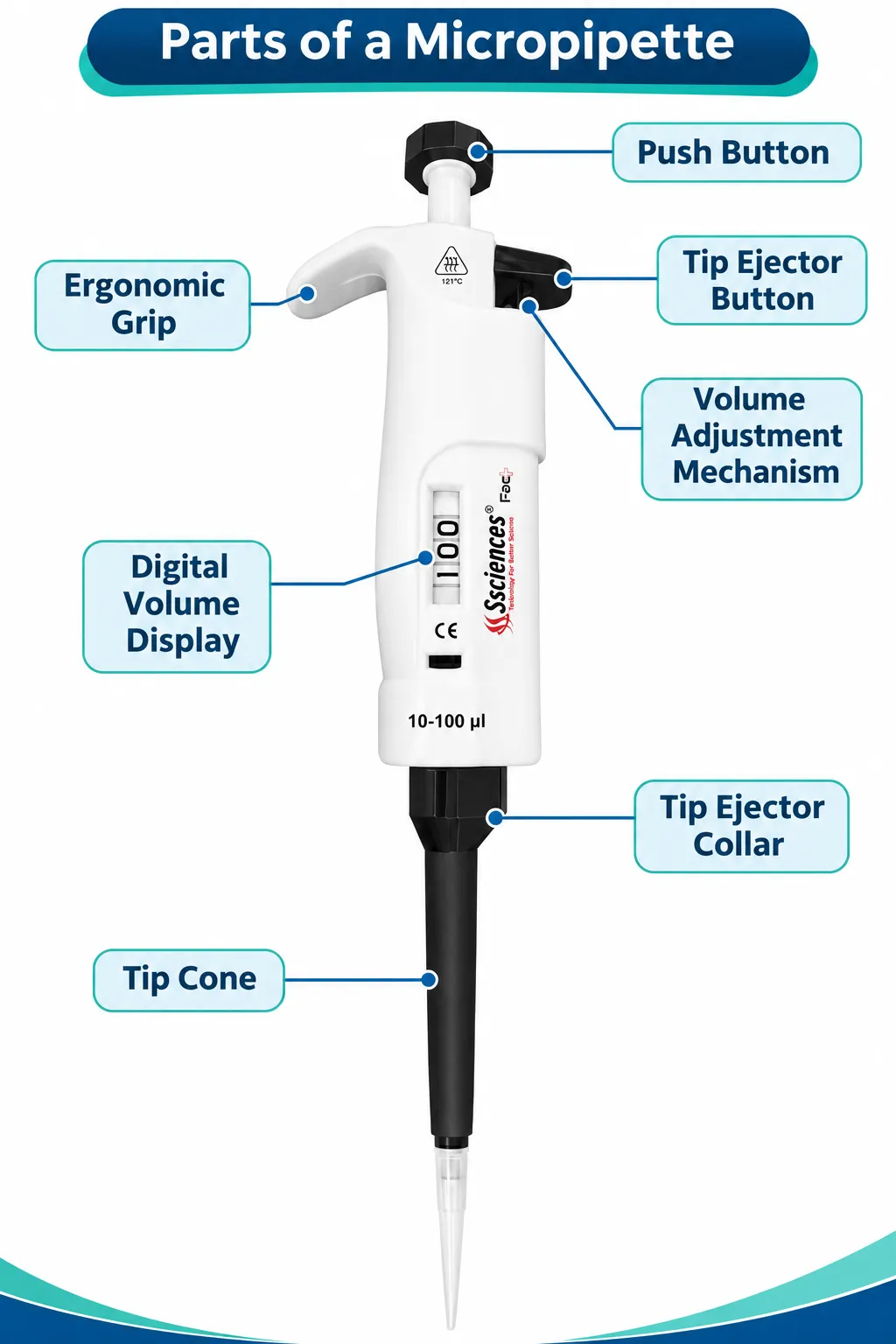
Common parts of a micropipette
A typical micropipette consists of:
- Push button: Used to operate the piston and control liquid aspiration and dispensing.
- Volume adjustment mechanism: Allows the user to select the required liquid volume.
- Digital volume display: Shows the selected volume.
- Tip ejector button: Helps remove the used pipette tip without direct contact.
- Tip ejector collar: Supports the tip ejection mechanism.
- Tip cone: Holds the compatible disposable pipette tip.
- Ergonomic grip: Provides comfortable handling during routine laboratory work.
Understanding these components helps users operate the instrument correctly and identify suitable features when comparing different models.
Why Is Choosing the Right Micropipette Important?
A micropipette is not simply a tool for transferring liquid. Its performance can influence the consistency of laboratory procedures and the reliability of experimental results.
Selecting a suitable instrument offers several practical advantages.
1. Better control over liquid transfer
A suitable micropipette allows users to transfer the volume required by their testing or research procedure. Choosing an appropriate volume range is particularly important when handling small quantities of samples or reagents.
2. Consistent laboratory results
Repeatable pipetting technique and a properly maintained instrument help reduce unnecessary variation between repeated transfers.
3. Improved working comfort
Laboratory professionals may perform hundreds of pipetting operations during a working day. A comfortable grip, smooth plunger movement and convenient tip ejection can make routine work easier.
4. Reduced handling errors
Clear volume displays, compatible tips, and an easy-to-operate adjustment mechanism can help users follow the correct pipetting procedure.
5. Better workflow efficiency
Choosing between single-channel and multichannel instruments according to the application can save time and make repetitive procedures more manageable.
Types of Micropipettes Available in India
Different laboratories have different liquid-handling requirements. A research laboratory may need several volume ranges, while a diagnostic laboratory may prioritise routine sample handling and convenient operation.
Here are some commonly available micropipette types.
1. Fixed Volume Micropipette
A fixed volume micropipette is designed to transfer one specified volume of liquid. The volume cannot be adjusted during normal operation.
It can be a practical option when the same volume is required repeatedly in a standardised procedure.
Common applications:
- Routine laboratory procedures
- Repetitive sample preparation
- Educational practicals
- Standardised liquid transfer tasks
The main advantage is straightforward operation. Before purchasing, confirm that the fixed volume matches your laboratory’s actual requirement.
2. Variable Volume Micropipette
A variable volume micropipette allows users to select different volumes within the instrument’s specified operating range.
It is useful for laboratories that perform multiple procedures and need flexibility while handling different quantities of liquid.
Common volume ranges offered in the market include:
- 0.5–10 µL
- 2–20 µL
- 10–100 µL
- 20–200 µL
- 100–1000 µL
- 1000–5000 µL
These are examples of commonly encountered ranges, not a guarantee that every manufacturer offers all configurations. Always check the current product specifications.
3. Single Channel Micropipette
A single-channel micropipette transfers liquid through one tip at a time.
It is one of the most versatile options for everyday laboratory work because it can be used with individual tubes, sample containers and other laboratory vessels.
Common applications include:
- Sample preparation
- Molecular biology
- Microbiology
- Diagnostic testing
- Analytical chemistry
- Pharmaceutical research
For laboratories handling different sample types and individual transfers, a single-channel model is often a sensible starting point.
4. Multichannel Micropipette
A multichannel micropipette is designed to transfer liquid through multiple tips simultaneously.
It is especially useful when working with microplates and repetitive liquid-handling procedures. Depending on the configuration, multichannel models may have 8 or 12 channels.
Common applications include:
- ELISA procedures
- PCR plate preparation
- Microplate testing
- High-throughput screening
- Repetitive sample distribution
Before purchasing, check the channel count, compatible plate format, tip compatibility and approved volume range.
5. Semi-Autoclavable Micropipette
Semi-autoclavable micropipettes have specific components that can be sterilised according to the manufacturer’s instructions.
They can be suitable for laboratories that require some sterilisation flexibility but do not necessarily need the entire instrument to undergo autoclaving.
Always verify which components can be autoclaved and follow the specified temperature, pressure, and exposure-time instructions.
6. Fully Autoclavable Micropipette
A fully autoclavable micropipette is designed to tolerate the specified autoclaving process as described by its manufacturer.
This type may be useful in laboratories where sterilisation requirements are an important part of daily operations.
However, the term fully autoclavable should always be checked against the manufacturer’s instructions. Users should not assume that every component or accessory can be sterilised under identical conditions.
How to Choose the Best Micropipette for Your Laboratory
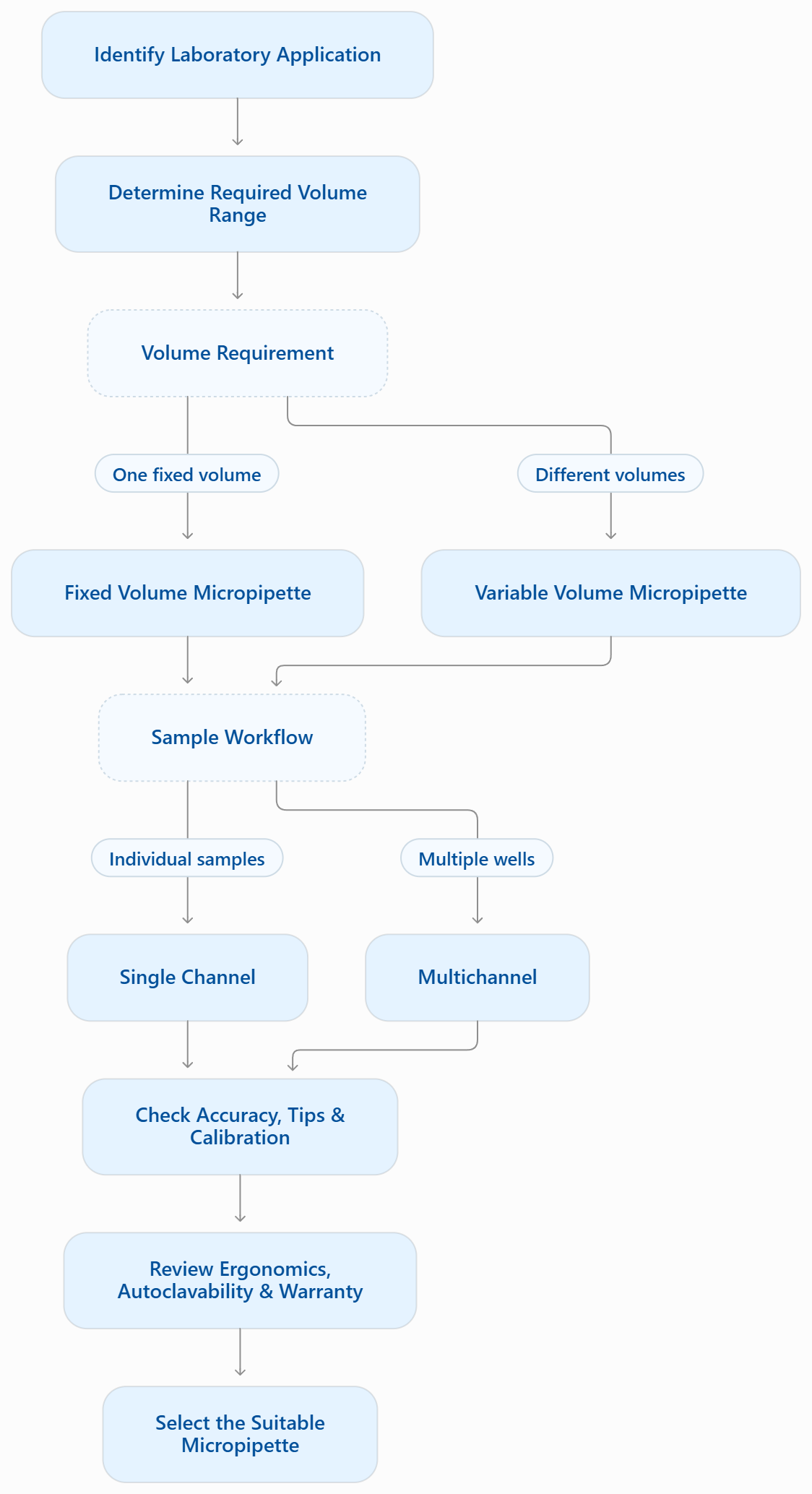
The best micropipette is the one that matches your actual laboratory workflow. Instead of selecting an instrument only because it is popular, consider the following factors.
1. Identify Your Required Volume Range
Start by identifying the minimum and maximum liquid volumes used in your regular procedures.
For example, a laboratory working mainly with small molecular biology samples may need a low-volume micropipette. A laboratory handling larger reagent volumes may require a higher-volume model.
Choosing the correct volume range helps prevent unnecessary instrument changes and makes routine work more convenient.
2. Decide Between Fixed and Adjustable Volume
If your procedure always requires the same volume, a fixed-volume micropipette may be sufficient.
If your laboratory performs different procedures with varying transfer volumes, an adjustable model may provide greater flexibility.
Consider your current requirements as well as the procedures you may introduce in the future.
3. Select the Appropriate Channel Configuration
Choose a single-channel model for individual sample transfers and a multichannel model when working with multiple wells or repetitive plate-based procedures.
A multichannel instrument is not automatically better for every laboratory. Its value depends on the number of samples, type of work and frequency of repetitive transfers.
4. Check Accuracy and Precision
Accuracy and precision are two important performance characteristics.
- Accuracy refers to how close the average delivered volume is to the selected volume.
- Precision refers to how closely repeated dispensing results agree with each other.
Both matter when comparing micropipettes.
Ask the supplier for relevant technical specifications and performance documentation. For applications requiring controlled measurement performance, check the applicable testing and calibration requirements.
5. Consider Ergonomic Design
A micropipette should feel comfortable during regular use.
Look for practical features such as:
- Comfortable grip
- Smooth plunger movement
- Convenient volume adjustment
- Easy tip ejection
- Clear volume display
- Suitable overall weight
These features become particularly important when laboratory professionals perform repetitive pipetting tasks.
6. Verify Pipette Tip Compatibility
The correct pipette tip is essential for reliable liquid handling.
An unsuitable or poorly fitted tip may cause leakage, inconsistent dispensing or handling difficulties.
Before purchasing, confirm the recommended tip type, fitting compatibility, and availability of replacement tips.
7. Check Calibration and Documentation
Calibration and performance verification are important parts of micropipette quality management.
Ask for the relevant calibration report, test documentation, and instrument specifications. Check whether the documentation identifies the instrument, tested volume points, results and applicable acceptance criteria.
If your laboratory requires NABL-accredited calibration, verify that the calibration laboratory’s current accreditation scope covers the relevant measurement and volume range. NABL accreditation applies to a laboratory’s defined scope, not automatically to every instrument sold by a supplier.
8. Compare Warranty and After-Sales Support
A micropipette is a working laboratory instrument that may need maintenance or servicing during its useful life.
Before buying, understand the warranty conditions, availability of spare parts, calibration support and service arrangements.
Good technical support can be as important as the initial purchase price.
Best Micropipette Brands in India: What Should Buyers Compare?
Several manufacturers and brands offer micropipettes in the Indian market. The right choice depends on your budget, required specifications, application and support expectations.
Instead of assuming that one brand is best for every laboratory, compare products using consistent criteria.
Important comparison points include:
- Available volume ranges
- Fixed or adjustable volume options
- Single-channel or multichannel configurations
- Accuracy and precision specifications
- Ergonomic design
- Autoclavability
- Tip compatibility
- Calibration documentation
- Warranty and service support
- Overall suitability for the intended application
Internationally recognised brands may be preferred for certain specialised workflows, while Indian manufacturers can offer practical product choices and local enquiry support.
The important point is to compare the actual model specifications rather than relying only on brand reputation.
Why Consider SSCIENCES for Micropipettes in India?
SSCIENCES, a brand of Singh Science Systems, is based in Lucknow and supplies scientific and laboratory products to customers across India.
The company offers micropipette solutions for different liquid-handling requirements, including single-channel, multichannel, mini, semi-autoclavable and fully autoclavable configurations.
Its product range is intended to support research, diagnostic, educational, and industrial laboratory applications.
What Does SSCIENCES Offer?
Single-channel micropipettes: Designed for routine liquid transfer and individual sample handling.
Multichannel micropipettes: Suitable for repetitive transfers and microplate-based laboratory workflows.
Mini micropipettes: Compact options for selected routine and educational applications.
Semi-autoclavable micropipettes: Options for laboratories with specific sterilisation requirements.
Fully autoclavable micropipettes: Designed for laboratory environments that require the specified autoclaving process.
A Quality-Focused Approach
SSCIENCES identifies itself as an ISO 9001:2015 certified company and focuses on practical laboratory product requirements, quality-oriented processes and customer support.
The company supports enquiries from laboratories, educational institutions, research facilities, diagnostic centres and scientific equipment buyers.
When selecting a product, customers should share their required volume range, application, preferred configuration and quantity so that the appropriate model can be identified.
To explore the product range, visit the SSCIENCES official website.
Micropipette Maintenance Tips for Long-Term Performance
Even a good-quality micropipette requires proper handling and maintenance. Following basic operating practices can help maintain its performance.
1. Use the Correct Pipette Tips
Always use tips recommended for the selected micropipette. Check that the tip is fitted properly before aspirating liquid.
2. Avoid Forceful Plunger Operation
Operate the plunger smoothly and follow the manufacturer’s recommended pipetting technique. Avoid unnecessary force during aspiration and dispensing.
3. Clean the Instrument Properly
Clean the external surfaces and serviceable components according to the manufacturer’s instructions. Do not use cleaning chemicals that may damage the instrument.
4. Store It Correctly
When not in use, store the micropipette in a suitable holder or storage position as recommended by the manufacturer. Avoid leaving it in conditions that may expose it to contamination, excessive heat, or physical damage.
5. Follow Calibration and Verification Schedules
Establish calibration or performance verification intervals according to usage, laboratory quality procedures, application risk, and instrument history.
A micropipette used frequently in critical testing may need more frequent checks than one used occasionally for basic educational work.
Common Mistakes to Avoid When Buying a Micropipette
Some purchasing mistakes can affect laboratory convenience and operating costs.
- Choosing only by price: A low initial cost does not always mean better long-term value.
- Ignoring the volume range: A micropipette should match the actual volumes used in your procedures.
- Overlooking tip compatibility: Confirm that suitable tips are readily available.
- Ignoring ergonomics: Uncomfortable instruments may make repetitive work more difficult.
- Not checking documentation: Request the technical specifications and relevant calibration information.
- Selecting the wrong channel type: Choose the configuration according to your sample and workflow requirements.
- Overlooking after-sales support: Understand warranty and service arrangements before purchasing.
Taking a little time to compare these factors can help you select an instrument that meets your laboratory’s needs.
Frequently Asked Questions About Micropipettes
1. Which is the best micropipette in India?
The best micropipette depends on your laboratory’s application, volume range, accuracy requirements, channel configuration, budget, and service expectations. Compare the technical specifications of individual models before making a decision.
2. Which micropipette is suitable for research laboratories?
Single-channel adjustable micropipettes are useful for many routine research applications. Multichannel models can be suitable for research workflows involving microplates and repetitive transfers.
3. What is the difference between a fixed-volume and variable-volume micropipette?
A fixed-volume micropipette transfers one specified volume, whereas a variable-volume micropipette allows users to select different volumes within its approved operating range.
4. Are autoclavable micropipettes better?
Autoclavability is useful when the laboratory’s procedures require sterilisation. However, it is not necessary for every application. Select a model according to your cleaning and contamination-control requirements.
5. How do I know whether a micropipette is accurate?
Review its technical specifications and relevant performance documentation. Calibration or gravimetric verification, performed using an appropriate procedure, can help assess delivered volume.
6. How often should a micropipette be calibrated?
There is no single interval suitable for every laboratory. The schedule should consider frequency of use, application risk, laboratory quality procedures, operating conditions and previous performance results.
7. Where can I buy a micropipette in India?
You can contact scientific instrument manufacturers and suppliers directly. SSCIENCES offers a range of micropipettes and liquid-handling products for laboratory requirements across India.
8. Does SSCIENCES offer single-channel and multichannel micropipettes?
Yes. SSCIENCES offers single-channel and multichannel micropipettes, including mini and autoclavable options.
Conclusion: Choose a Micropipette That Fits Your Laboratory
Choosing the best micropipette in India is about finding the right balance between performance, usability, volume range, documentation, and long-term support.
A suitable instrument should match your laboratory’s daily procedures and provide the features needed for accurate and consistent liquid handling. Whether you need a single-channel model for routine sample preparation or a multichannel micropipette for plate-based work, reviewing the specifications before purchasing is always worthwhile.
SSCIENCES offers micropipette configurations for research, diagnostics, education, and industrial laboratory needs.
Looking for a suitable micropipette for your laboratory?
Contact Singh Science Systems to discuss your required volume range, application, and product configuration.
Website: https://www.ssciences.com/
Phone: +91 9266169685
Email: singhsciencesystems@gmail.com
Best Micropipette in India – https://www.moglix.com/ssciences-20-200l-variable-mechanical-operation-micropipette-sssvve0200/mp/msno5wnonwjw51