
Micropipette Price in India: Complete Buying Guide (2026)
If you ask three suppliers for a micropipette quotation in India, you’ll likely receive three very different prices—even when the products look similar on paper.
That happens because micropipette prices in India are not determined by one factor.
The final cost depends on the pipette type, volume range, number of channels, accuracy and precision specifications, autoclavability, manufacturing quality, calibration documentation, warranty, brand origin, and even the quantity being purchased.
A basic fixed-volume micropipette may cost only a few hundred rupees, while premium variable-volume or multichannel models can cost several thousand rupees. Imported laboratory micropipettes may cost substantially more.
This guide explains the typical micropipette price ranges in India, what actually changes the price, how Indian-manufactured and imported micropipettes compare, the hidden costs buyers often overlook, and what you should check before accepting a quotation.
What Determines Micropipette Price in India?
Several factors explain why two micropipettes that look almost identical can have very different prices.
Understanding these factors is more useful than simply looking for the cheapest product.
1. Fixed Volume vs. Variable Volume Micropipette
A fixed-volume micropipette is designed to dispense one predetermined volume.
For example:
- 5 µL
- 10 µL
- 20 µL
- 50 µL
- 100 µL
- 200 µL
- 500 µL
- 1000 µL
Because the internal mechanism does not require an adjustable volume-setting system, fixed-volume pipettes are generally mechanically simpler and often more economical.
A variable-volume micropipette, by comparison, allows the user to select different volumes within a defined range.
Common ranges may include:
- 0.2–2 µ
- 0.5–10 µL
- 2–20 µL
- 5–50 µL
- 10–100 µL
- 20–200 µL
- 100–1000 µL
The adjustable mechanism, volume display, locking system, and additional internal components generally make variable-volume micropipettes more expensive than equivalent fixed-volume models.
2. Single-Channel vs. Multichannel Micropipette
A single-channel micropipette dispenses liquid through one pipette tip.
It is suitable for:
- General laboratory work
- Sample preparation
- PCR preparation
- Clinical laboratories
- Chemistry laboratories
- Research laboratories
- Educational laboratories
A multichannel micropipette usually has 8 or 12 channels and can dispense several samples simultaneously.
Multichannel pipettes are particularly useful for:
- ELISA
- Microplates
- PCR plates
- High-throughput sample preparation
- Repetitive dispensing
Manufacturing a multichannel pipette is more complex because every channel needs consistent aspiration and dispensing performance.
For this reason, multichannel micropipette prices in India are considerably higher than single-channel micropipette prices.
3. Volume Range and Precision Requirements
The required liquid volume also affects the cost.
Handling very small volumes requires tighter manufacturing tolerances because even a tiny variation in piston movement can represent a significant percentage error.
For example, an error of 0.5 µL is relatively small when dispensing 1000 µL but extremely significant when dispensing only 5 µL.
Micropipettes designed for very small liquid volumes therefore require:
- Precision piston movement
- Reliable seals
- Consistent air displacement
- Tight manufacturing tolerances
- Good tip sealing
These requirements can influence the final price.
4. Autoclavability
Autoclavability is another important factor affecting micropipette cost in India.
A micropipette may be:
- Non-autoclavable
- Semi-autoclavable
- Fully autoclavable
A semi-autoclavable micropipette generally allows the designated lower assembly to be sterilized.
A fully autoclavable micropipette is designed for broader sterilization capability according to the manufacturer’s specified procedure.
Fully autoclavable designs generally require materials and components capable of tolerating repeated exposure to steam and high temperatures.
That can increase manufacturing cost.
To understand this difference in detail, read our guide on fully autoclavable vs. semi-autoclavable micropipettes.
5. Calibration Documentation
Calibration documentation can also influence the quotation.
Some micropipettes may be supplied with:
- Manufacturer calibration report
- Calibration certificate
- Traceability documentation
- Individual test results
Others may be sold without detailed calibration documentation.
When comparing prices, always check whether calibration documentation is included.
A lower-priced micropipette without required calibration documentation may not actually be cheaper once the additional calibration cost is included.
6. Indian-Manufactured vs. Imported Micropipette
Brand origin can create one of the largest differences in micropipette pricing.
Imported micropipettes often include additional costs associated with:
- Import logistics
- International distribution
- Brand premium
- Overseas supply chains
- Currency fluctuations
- Distributor margins
- International service networks
Indian manufacturers can often offer more competitive pricing because manufacturing and service support are available domestically.
Micropipette Price in India by Type
Based on the market ranges compiled in the source material, mechanical micropipette pricing in India may broadly fall within the following bands:
Micropipette Type |
Typical Price Range |
|---|---|
| Fixed-volume single-channel micropipette | ₹600 – ₹2,500 |
| Variable-volume single-channel micropipette | ₹800 – ₹5,000+ |
| 8-channel multichannel micropipette | ₹5,000 – ₹12,000 |
| 12-channel multichannel micropipette | ₹9,000 – ₹18,000 |
| Premium / imported micropipette | Often 2–3× comparable Indian-manufactured models, sometimes above ₹30,000 |
These figures should be treated as indicative market ranges rather than a fixed SSCIENCES price list.
Actual pricing can change according to:
- Model
- Volume range
- Quantity
- Calibration requirements
- Accessories
- Warranty
- Seller
- Shipping
- Applicable taxes
- Institutional purchase terms
For accurate purchasing decisions, request a quotation based on your exact requirements.
Single-Channel Micropipette Price in India
Single-channel micropipettes are the most commonly used laboratory pipettes and usually offer the widest price range.
A basic fixed-volume model may fall toward the lower end of the market, while a premium adjustable micropipette with better ergonomics, higher-quality materials, calibration documentation, and autoclavability may cost considerably more.
When comparing single-channel pipettes, check:
- Fixed or variable volume
- Volume range
- Accuracy
- Precision
- Autoclavability
- Calibration certificate
- Warranty
- Service availability
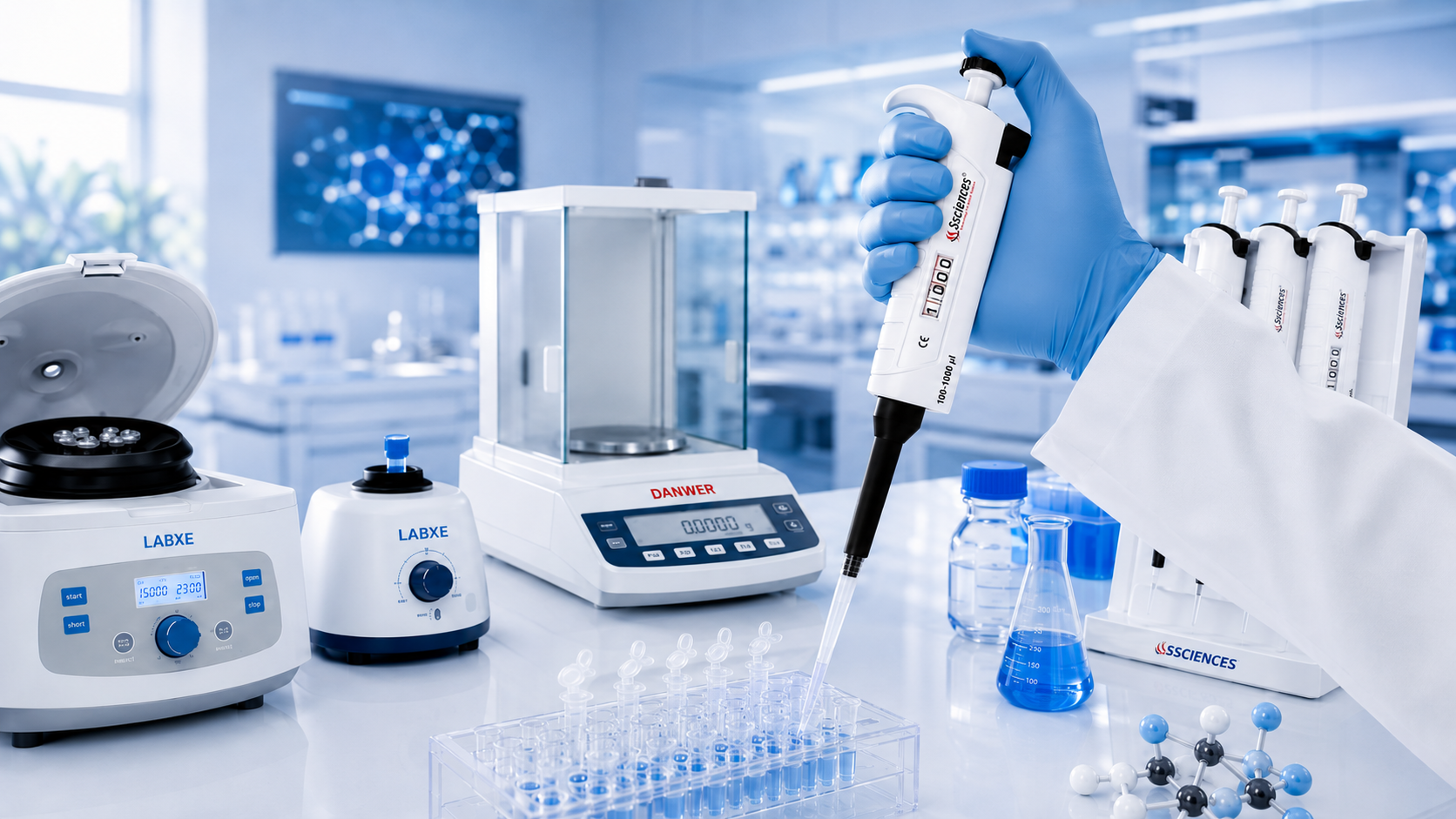
Do not compare two single-channel micropipettes purely because both have the same nominal volume.
The internal design and included documentation may be completely different.
Multichannel Micropipette Price in India
A multichannel micropipette generally costs more because it contains multiple simultaneous liquid-handling channels.
Common configurations include:
- 8-channel micropipette
- 12-channel micropipette
Each channel must deliver liquid consistently.
The manufacturing challenge is therefore not simply multiplying a single-channel pipette by eight or twelve.
Uniform performance across channels requires greater mechanical precision.
For laboratories working with microplates, however, the productivity benefits can justify the higher purchase cost.
A multichannel pipette can significantly reduce the time required for:
- ELISA
- PCR
- Serial dilution
- Plate preparation
- Reagent dispensing
When evaluating a multichannel micropipette price, calculate the value in terms of both purchase cost and technician time saved.
Indian-Manufactured vs. Imported Micropipettes
Imported laboratory instruments often carry a significant price premium in India.
However, a higher price does not automatically mean that the pipette will be more accurate simply because it is imported.
A more useful comparison includes:
- Accuracy specification
- Precision specification
- Manufacturing consistency
- Calibration documentation
- Warranty
- Local service support
- Replacement-part availability
- Tip compatibility
- Turnaround time for repairs
An established imported brand may provide strong international recognition and an extensive global service network.
An Indian manufacturer may provide:
- More competitive pricing
- Faster domestic service
- Easier communication
- Faster replacement-part availability
- Institutional pricing
- OEM possibilities
- Shorter supply lead times
For laboratories purchasing multiple micropipettes, these practical factors can have a significant effect on long-term cost.
SSCIENCES operates under ISO 9001:2015 and ISO 13485:2016 certified manufacturing, supporting quality-management practices for laboratory liquid-handling products.
Does a More Expensive Micropipette Mean Better Accuracy?
Not necessarily.
Price and quality can be related, but price alone does not prove accuracy.
A micropipette should instead be evaluated using measurable specifications such as:
- Systematic error
- Random error
- Accuracy
- Precision
- Calibration performance
- Mechanical consistency
A reputable manufacturer should be able to provide clear technical specifications for the product.
Do not assume that an expensive imported micropipette must automatically outperform every Indian-manufactured model.
Likewise, do not assume that the cheapest micropipette is the best value simply because its purchase price is lower.
The Hidden Cost of a Micropipette
The price printed on a quotation is only the initial purchase cost.
A laboratory should also consider the total cost of ownership.
This can include:
- Pipette tips
- Calibration
- Repairs
- Spare parts
- Downtime
- Repeated experiments
- Technician time
- Service logistics
These costs can eventually exceed the original purchase price.
Pipette Tips
Tips are consumed continuously throughout the life of a micropipette.
If a pipette requires expensive proprietary tips, the laboratory may spend considerably more on consumables over several years.
Before purchasing, ask:
Does the micropipette work reliably with commonly available compatible tips?
For high-volume laboratories, this question can be as important as the instrument price itself.
Calibration Cost
Micropipettes require periodic performance verification and calibration.
Calibration frequency depends on:
- Usage
- Application criticality
- Laboratory procedure
- Calibration history
- Regulatory requirements
A micropipette that loses performance frequently may require more servicing and calibration over its lifetime.
Read our detailed guide on how to calibrate a micropipette for more information about gravimetric calibration and pipette performance checking.
Downtime
A low-cost micropipette that repeatedly requires service can become expensive because laboratory work is interrupted.
Possible consequences include:
- Delayed experiments
- Repeated tests
- Replacement equipment requirements
- Technician downtime
- Missed laboratory schedules
For commercial, diagnostic, pharmaceutical, or QC laboratories, downtime can be much more expensive than the original difference in pipette price.
Repeat Testing and Reagent Waste
An inaccurate micropipette may silently introduce dispensing errors.
Unlike electronic equipment that displays an error code, a mechanical pipette may continue operating normally while delivering an incorrect volume.
This can result in:
- Failed PCR
- Poor standard curves
- Inconsistent ELISA results
- Incorrect sample dilution
- Failed replicates
- Reagent waste
- Repeated analysis
The cost of repeating one sensitive experiment may exceed the difference between a budget micropipette and a better-quality instrument.
How to Read a Micropipette Quotation
Never compare two quotations using only the final number.
Before selecting the lower quotation, confirm whether both suppliers are actually offering the same package.
A proper micropipette quotation should ideally specify:
Accuracy and Precision
The quotation or technical specification should clearly state the expected accuracy and precision for the relevant volume range.
Calibration Certificate
Check whether a calibration certificate or test report is included.
Ask:
- Is calibration documentation included?
- Is every pipette individually tested?
- Is the certificate traceable where required?
Warranty
Check:
- Warranty duration
- Parts coverage
- Labour coverage
- Exclusions
- Service location
A longer warranty has limited value if obtaining service is extremely difficult.
Tip Compatibility
Confirm whether the pipette requires:
- Proprietary tips
- Manufacturer-specific tips
- Standard compatible tips
Consumable cost can significantly affect long-term ownership cost.
Autoclavability
Determine whether the micropipette is:
- Fully autoclavable
- Semi-autoclavable
- Non-autoclavable
Read our guide on fully autoclavable and semi-autoclavable micropipettes before choosing based on this specification.
Taxes and Shipping
Always confirm whether the quoted price includes:
- Applicable GST
- Shipping
- Packing
- Insurance
- Other charges
Two quotations cannot be accurately compared unless both use the same pricing basis.
Quantity Discount
If you need several micropipettes, do not simply multiply the single-unit price.
Ask for:
- Institutional pricing
- Laboratory package pricing
- Dealer pricing where applicable
- Bulk purchase pricing
- Manufacturers may provide better per-unit pricing for larger orders.
Micropipette Price vs. Quality
Choosing the cheapest micropipette can look attractive when preparing a procurement budget.
However, laboratory instruments should not be evaluated in the same way as ordinary low-risk commodities.
The real question is:
How much useful and reliable service will the laboratory receive for the money spent?
A slightly higher initial price may provide better value when it offers:
- Better manufacturing consistency
- More reliable accuracy
- Easier calibration
- Better durability
- Longer service life
- Better warranty
- Faster service
- Lower consumable cost
- At the same time, buying the most expensive product simply because it carries an international brand name may not always be necessary.
The correct approach is to compare technical performance + service + total ownership cost, not just brand or purchase price.
Micropipette Budget Guide by Laboratory Type
Different laboratories should prioritize different features.
Teaching and Educational Laboratories
Educational institutions may require many micropipettes simultaneously.
Typical priorities include:
- Affordable unit price
- Durability
- Easy operation
- Simple maintenance
- Standard tip compatibility
- Bulk pricing
Because multiple units may be required for students or laboratory benches, institutional pricing can have a major impact on the final budget.
Research Laboratories
Research laboratories performing:
- PCR
- ELISA
- Molecular biology
- Biotechnology
- Analytical research
should give greater weight to:
- Accuracy
- Precision
- Calibration documentation
- Consistency
- Ergonomics
- Autoclavability where required
The cost of one failed experiment may be greater than the price difference between two micropipette models.
Clinical and Diagnostic Laboratories
Diagnostic laboratories should place strong emphasis on:
- Reliable accuracy
- Calibration traceability
- Service availability
- Documentation
- Quality management
- Maintenance history
Results produced in diagnostic environments may have consequences beyond the laboratory itself.
For this reason, choosing only on the basis of lowest price can create unnecessary risk.
Pharmaceutical and QC Laboratories
Quality-control and pharmaceutical laboratories may operate larger fleets of micropipettes.
Important purchasing factors include:
- Consistent performance
- Documentation
- Service contract availability
- Bulk pricing
- Calibration management
- Spare-part availability
- Total fleet ownership cost
For larger laboratories, even a small difference in maintenance cost per pipette can become significant across dozens of instruments.
Common Mistakes When Buying a Micropipette
Choosing Only by Lowest Price
A lower price may exclude:
- Calibration
- Warranty
- Accessories
- Better materials
- Service support
Always compare the complete package.
Ignoring Tip Compatibility
Consumable cost continues long after the micropipette has been purchased.
Always check tip compatibility before selecting the instrument.
Ignoring Calibration Documentation
A low-cost micropipette may appear attractive until a separate calibration certificate is required.
Confirm documentation before placing the order.
Not Asking for Bulk Pricing
Institutions purchasing several pipettes should request a specific institutional quotation.
The listed single-unit price may not represent the actual price available for a larger order.
Ignoring Service Availability
A micropipette will eventually require:
- Calibration
- Maintenance
- Seal replacement
- Cleaning
- Repair
Local service availability can therefore be extremely valuable.
What Should You Ask Before Buying a Micropipette?
Use this checklist before finalizing your purchase:
[ ] What is the required volume range?
[ ] Fixed or variable volume?
[ ] Single-channel or multichannel?
[ ] What are the accuracy specifications?
[ ] What are the precision specifications?
[ ] Is a calibration certificate included?
[ ] Is the micropipette fully or semi-autoclavable?
[ ] Which pipette tips are compatible?
[ ] What warranty is included?
[ ] Where is service provided?
[ ] Are spare parts available?
[ ] Are GST and shipping included?
[ ] Is institutional or bulk pricing available?
[ ] What is the expected long-term ownership cost?
Using this checklist makes it much easier to compare quotations fairly.
Frequently Asked Questions
How Much Does a Micropipette Cost in India?
Mechanical single-channel micropipettes may broadly range from approximately ₹600 for basic fixed-volume models to ₹5,000 or more for higher-specification variable-volume models.
Multichannel micropipettes may commonly range from approximately ₹5,000 to ₹18,000, depending on the number of channels and product specifications.
Imported models can cost considerably more.
Always request a specific quotation for the required model and quantity.
Why Do Micropipette Prices Vary So Much?
Micropipette prices vary because the product category alone does not describe:
- Manufacturing quality
- Internal materials
- Volume mechanism
- Calibration documentation
- Autoclavability
- Warranty
- Service
- Brand origin
- Number of channels
Two pipettes that appear similar may therefore have very different manufacturing and service costs.
Is an Imported Micropipette More Accurate Than an Indian Micropipette?
Not automatically.
Accuracy should be evaluated using the manufacturer’s performance specifications and calibration results rather than country of origin alone.
Imported products may command higher prices because of global branding, international distribution, and service networks, but this does not automatically guarantee better accuracy than a well-manufactured Indian micropipette.
Does Micropipette Price Include a Calibration Certificate?
Not always.
Some suppliers include calibration documentation while others charge separately.
Always confirm this before comparing quotations.
Is It Cheaper to Buy Micropipettes in Bulk?
Usually, institutional and multi-unit buyers may be able to obtain better per-unit pricing than buyers purchasing a single instrument.
Ask the manufacturer for an institutional or bulk quotation.
How Much Does Micropipette Maintenance Cost?
Maintenance costs depend on:
- Pipette usage
- Calibration frequency
- Tip usage
- Seal replacement
- Repairs
- Service provider
Include these recurring expenses when calculating total cost of ownership.
What Is the Best Micropipette for a Laboratory?
There is no single best micropipette for every laboratory.
The right instrument depends on:
- Application
- Volume range
- Accuracy requirements
- Number of samples
- Sterilization needs
- Laboratory budget
- Calibration requirements
A teaching laboratory and a diagnostic laboratory may therefore need completely different micropipette specifications.
Getting the Right Micropipette Price for Your Laboratory
Online price ranges are useful for preparing an initial budget, but the most accurate price depends on your actual requirements.
Before requesting a quotation, determine:
- Required volume range
- Fixed or variable volume
- Single-channel or multichannel
- Quantity
- Autoclavability requirement
- Calibration documentation
- Application
- Delivery location
Providing these details allows the manufacturer to prepare a quotation that reflects your laboratory’s needs instead of a generic price.
SSCIENCES manufactures laboratory micropipettes for different liquid-handling requirements, including fixed-volume, variable-volume, single-channel, multichannel, semi-autoclavable, and fully autoclavable configurations.
Request a Quote from the SSCIENCES team for current pricing based on your required model, volume range, quantity, and application.
Contact Us: Buy Ssciences Micropipette Online at Best Prices in India | 28 Sep 2026