
Micropipette Price in India: 7 Factors to Consider Before Buying
When purchasing laboratory equipment, price is often one of the first things buyers consider. However, when it comes to a micropipette, selecting the cheapest option is not always the best decision. A suitable micropipette should offer the right volume range, comfortable operation, reliable liquid handling, and appropriate technical support for the laboratory’s requirements.
Micropipettes are widely used in research laboratories, diagnostic centres, pharmaceutical companies, biotechnology facilities, educational institutions, and industrial testing laboratories. Since different applications require different liquid volumes and instrument configurations, micropipette prices can vary considerably.
If you are searching for the micropipette price in India, it is important to understand what influences the cost before requesting a quotation. Two instruments may look similar but have different internal mechanisms, performance specifications, materials, calibration documentation, and warranty conditions.
This guide explains the different types of micropipettes, typical price ranges, cost factors, and practical points to check before purchasing.
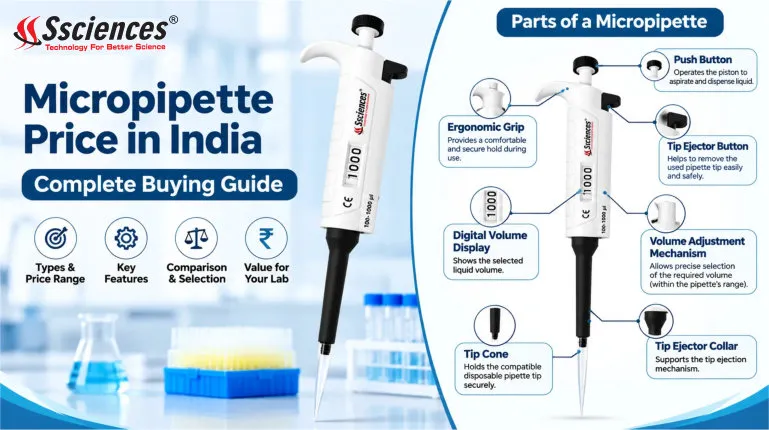
What Is a Micropipette?
A micropipette is a precision laboratory instrument used to measure and transfer small quantities of liquid, usually expressed in microliters (µL).
It is commonly used for sample preparation, reagent transfer, dilution, and other laboratory operations that require controlled liquid volumes.
Most conventional air-displacement micropipettes operate through a piston mechanism. When the user presses and releases the push button, the instrument creates pressure changes that draw liquid into a disposable pipette tip. The liquid can then be dispensed into another container.
Micropipettes are available in different designs, including fixed-volume, adjustable-volume, single-channel, and multichannel models.
Micropipette Price in India: Indicative Price Ranges
The price of a micropipette depends on its design, volume range, number of channels, performance requirements, manufacturer, and included accessories.
The following are indicative market price bands published in the SSCIENCES buying guide. They are budgeting references, not guaranteed current selling prices or a formal SSCIENCES quotation.
| Micropipette type | Indicative price range |
|---|---|
| Fixed-volume single-channel | ₹600–₹2,500 |
| Variable-volume single-channel | ₹800–₹5,000+ |
| 8-channel multichannel | ₹5,000–₹12,000 |
| 12-channel multichannel | ₹9,000–₹18,000 |
| Premium or imported models | Can exceed ₹30,000 |
Actual prices may differ according to the product model, volume range, brand, quantity, calibration requirements, warranty, shipping and applicable taxes.
For an accurate price, request a quotation for the specific micropipette configuration you need.
7 Factors That Affect Micropipette Price in India
Understanding the following factors will help you compare products more effectively.
1. Fixed Volume vs. Adjustable Volume
One of the first differences affecting micropipette cost is the volume adjustment mechanism.
Fixed-volume micropipette
A fixed-volume micropipette is designed to dispense one predetermined volume. For example, a laboratory may require a 10 µL, 20 µL, 50 µL or 100 µL model for a repetitive procedure.
Since the volume does not need to be adjusted during normal operation, this type of instrument generally has a simpler mechanism and may be more economical.
Adjustable-volume micropipette
An adjustable-volume micropipette allows users to select different volumes within its specified operating range.
Common examples include:
- 0.5–10 µL
- 2–20 µL
- 10–100 µL
- 20–200 µL
- 100–1000 µL
- 1000–5000 µL
The adjustment mechanism and volume display add to the instrument’s design requirements.
If your laboratory handles different sample volumes, an adjustable model may offer greater flexibility. If the same volume is used repeatedly, a fixed-volume model may be sufficient.
2. Single-Channel vs. Multichannel Micropipette
The number of channels also affects the purchase price.
A single-channel micropipette transfers liquid through one tip at a time. It is widely used for general laboratory work, sample preparation, research and diagnostic procedures.
A multichannel micropipette transfers liquid through multiple tips simultaneously. Common configurations include 8-channel and 12-channel models.
Multichannel instruments are useful for:
- ELISA procedures
- PCR plate preparation
- Microplate testing
- Repetitive sample distribution
- High-throughput screening
Multichannel models generally cost more because their design requires multiple channels to work consistently.
Although the initial investment is higher, they can reduce the time needed for repetitive plate-based procedures.
3. Volume Range and Performance Requirements
The volume range is another important consideration.
Micropipettes designed for very small liquid volumes may require tighter mechanical tolerances and more demanding performance specifications.
For example, a low-volume instrument used in molecular biology may have different performance requirements from a higher-volume pipette used for routine reagent transfer.
When comparing prices, check:
- Minimum and maximum volume
- Accuracy specifications
- Precision specifications
- Selected test volumes
- Recommended pipette tips
- Applicable performance requirements
Do not assume that two micropipettes are equivalent simply because they have a similar volume range.
4. Autoclavability and Material Design
Some laboratories require sterilisation of their liquid-handling instruments as part of their cleaning and contamination-control procedures.
Micropipettes may be available in different configurations.
Standard micropipette: Designed for routine liquid handling and cleaned according to the manufacturer’s instructions.
Semi-autoclavable micropipette: Has specified components that can undergo the approved autoclaving process.
Fully autoclavable micropipette: Designed to tolerate the manufacturer’s specified autoclaving procedure.
Autoclavability may influence the materials and construction used in an instrument, which can affect its cost.
Before purchasing, confirm exactly which components can be autoclaved and follow the manufacturer’s recommended temperature, pressure and exposure time.
5. Accuracy, Precision and Calibration
A micropipette should be evaluated according to its performance specifications rather than price alone.
Accuracy refers to how close the average delivered volume is to the intended volume.
Precision refers to how closely repeated dispensing results agree with one another.
Both are important for laboratory procedures where liquid volume influences the outcome.
Buyers should ask for relevant technical documentation, including:
- Accuracy specifications
- Precision specifications
- Calibration or performance test report
- Tested volume points
- Acceptance criteria
- Recommended verification intervals
ISO 8655-2:2022 specifies metrological requirements and maximum permissible errors for specified single-channel and multichannel pipettes, including their selected tips and other essential consumable parts.
If your laboratory requires NABL-accredited calibration, verify that the calibration laboratory’s current accreditation scope covers the required measurement and volume range.
Remember that a calibration certificate and a product manufacturer’s quality certification are not the same thing.
6. Brand, Manufacturer and After-Sales Support
Brand and manufacturer can influence the final price.
Imported micropipettes may include additional costs associated with international shipping, distribution, currency fluctuations and brand positioning.
Indian manufacturers and suppliers may offer practical advantages such as domestic communication, local supply arrangements and easier access to technical support.
Before selecting a manufacturer, compare:
- Product specifications
- Available volume ranges
- Manufacturing quality information
- Calibration documentation
- Warranty conditions
- Replacement-part availability
- Technical support
- Delivery arrangements
A lower purchase price may not provide good long-term value if the instrument is difficult to maintain or service.
7. Quantity, Accessories and Purchase Requirements
The number of instruments required can affect the final quotation.
A laboratory purchasing one micropipette may receive a different price from an institution ordering multiple units.
Other factors that can influence the final amount include:
- Compatible pipette tips
- Storage stands
- Calibration services
- Accessories
- Warranty coverage
- Packaging
- Shipping
- GST
- Institutional purchase conditions
If you are purchasing for a college, hospital, research institution, or laboratory, ask the supplier for a quotation based on the complete quantity and product requirement.
Price Comparison: Indian-Manufactured vs. Imported Micropipettes
Both Indian-manufactured and imported micropipettes are available in the Indian market.
The right choice depends on your budget, technical requirements, and expectations for support.
| Comparison point | Indian-manufactured | Imported |
|---|---|---|
| Purchase cost | May be more competitive | May include import and distribution costs |
| Product range | Depends on manufacturer | Depends on international brand |
| Technical support | Domestic support may be easier to access | Depends on local distributor |
| Spare parts | Check local availability | Check distributor availability |
| Brand recognition | Varies by manufacturer | Varies by international brand |
| Warranty | Depends on supplier | Depends on brand and distributor |
An imported micropipette is not automatically more accurate because of its country of origin. Similarly, a lower-priced Indian instrument should not be assumed to offer the same specifications as every imported model.
Compare the actual product specifications, documentation, and service arrangements before making a decision.
Hidden Costs to Consider Before Buying a Micropipette
The purchase price is only one part of the total cost of owning a micropipette.
Laboratories should also consider recurring expenses.
1. Pipette Tips
Pipette tips are consumables that may be used frequently.
Before buying a micropipette, check the compatible tip type and its availability. If the instrument requires expensive or difficult-to-source tips, the long-term operating cost may increase.
2. Calibration and Verification
Micropipettes may require periodic calibration or performance verification depending on usage, laboratory procedures and application risk.
Include these requirements in your purchasing budget, especially if the instrument will be used for critical testing or quality-control work.
3. Maintenance and Repairs
Instruments may require cleaning, seal replacement, servicing, or other maintenance during their working life.
Ask about the availability of spare parts and the process for obtaining technical assistance.
4. Laboratory Downtime
An instrument that repeatedly requires repair can interrupt routine work.
For busy laboratories, delays in sample preparation or testing may create additional operational costs.
5. Repeat Testing and Reagent Waste
Poor pipetting technique, incompatible tips, or an instrument that does not meet the required performance can contribute to inconsistent results.
This may lead to repeated experiments, wasted reagents, and additional technician time.
For this reason, comparing the total cost of ownership is more useful than considering only the initial purchase amount.
How to Choose the Right Micropipette for Your Laboratory
Before requesting a quotation, understand your laboratory’s actual requirements.
Research Laboratories
Research laboratories may handle a variety of liquid volumes during experimental work.
Adjustable-volume micropipettes can be useful where procedures involve different sample and reagent quantities.
Diagnostic Laboratories
Diagnostic laboratories should pay attention to performance documentation, calibration requirements, maintenance, and the suitability of the instrument for their testing procedures.
Educational Laboratories
Colleges and training institutions may require several micropipettes for student practicals.
In this situation, volume range, ease of use, durability, availability, and institutional pricing are important considerations.
Pharmaceutical and Quality-Control Laboratories
These laboratories may have formal documentation and performance verification requirements.
Buyers should confirm technical specifications, calibration arrangements, cleaning procedures, and service support before placing an order.
How to Compare Two Micropipette Quotations
Never select a supplier simply because the final quoted amount is lower.
Use the following comparison checklist:
| Purchasing factor | What to verify |
|---|---|
| Model | Exact product model and configuration |
| Volume range | Required minimum and maximum volume |
| Channel type | Single-channel or multichannel |
| Accuracy | Manufacturer’s stated specifications |
| Precision | Manufacturer’s stated specifications |
| Tips | Compatibility and availability |
| Calibration | Certificate or report included? |
| Autoclavability | Full, partial, or not autoclavable |
| Warranty | Duration and coverage |
| Service | Availability and location |
| GST | Included or extra |
| Shipping | Included or extra |
Comparing quotations on the same basis makes it easier to identify genuine value.
Why Consider SSCIENCES for Micropipettes?
SSCIENCES, a brand of Singh Science Systems, provides micropipettes and liquid-handling products for research, diagnostic, educational and industrial laboratory applications.
Based in Lucknow, the company serves laboratory and scientific equipment customers across India.
Its product range includes:
Single-channel micropipettes: Suitable for individual sample transfer and routine liquid-handling procedures.
Multichannel micropipettes: Designed for simultaneous liquid transfer in microplate-based and repetitive workflows.
Mini micropipettes: Compact options for selected educational and laboratory applications.
Semi-autoclavable micropipettes: Options for laboratories requiring sterilisation of specified components.
Fully autoclavable micropipettes: Designed for use where the manufacturer’s approved autoclaving procedure is required.
Bottle-top dispensers: Additional liquid-handling solutions for controlled dispensing directly from reagent bottles.
SSCIENCES identifies itself as an ISO 9001:2015 certified company and focuses on quality-oriented processes and practical laboratory product requirements.
When enquiring, customers can share their required volume range, application, configuration, and quantity to help identify a suitable product.
You can explore the product range through the SSCIENCES website or contact the team for current pricing.
Frequently Asked Questions About Micropipette Prices
1. What is the price of a micropipette in India?
The price varies according to the type, volume range, channel configuration, manufacturer, and included documentation. Indicative market ranges for mechanical models can start around ₹600, while multichannel and premium models can cost considerably more. Request a current quotation for an exact price.
2. What is the price of a single-channel micropipette?
A basic fixed-volume single-channel micropipette may be less expensive than an adjustable-volume model. The final cost depends on the volume range, performance specifications, materials, calibration documentation, and warranty.
3. What is the price of an 8-channel micropipette in India?
An 8-channel micropipette may fall within an indicative market range of ₹5,000–₹12,000. Actual prices depend on the model, specifications, manufacturer, and purchase conditions.
4. What is the price of a 12-channel micropipette?
A 12-channel micropipette may fall within an indicative market range of ₹9,000–₹18,000. Contact suppliers for current model-specific pricing.
5. Is an adjustable micropipette more expensive than a fixed-volume model?
Generally, an adjustable-volume micropipette has a more complex volume-setting mechanism. Its price may therefore be higher than a comparable fixed-volume model.
6. Does micropipette price include a calibration certificate?
Not always. Calibration documentation may be included in some quotations and charged separately in others. Confirm this with the supplier before purchasing.
7. Is an imported micropipette better than an Indian-manufactured model?
Not automatically. Compare accuracy, precision, technical specifications, documentation, warranty, and service availability instead of relying only on country of origin.
8. Can I get a discount when purchasing micropipettes in bulk?
Institutional and bulk orders may qualify for different pricing arrangements. Share the required quantity and product configuration with the supplier to request a quotation.
9. How do I select the right micropipette for my laboratory?
Identify the required volume range, application, channel configuration, tip compatibility, performance requirements, and maintenance needs. Then compare suitable models.
10. Where can I enquire about micropipette prices in India?
You can contact SSCIENCES, Singh Science Systems, for information about its micropipette range and current quotations.
Conclusion: Choose Value, Not Just the Lowest Price
Finding the right micropipette is about balancing price, performance, usability, and long-term maintenance.
Before purchasing, compare the volume range, channel configuration, accuracy, precision, tip compatibility, calibration documentation, and warranty. These factors will help you understand whether a product is suitable for your laboratory rather than relying only on its advertised price.
SSCIENCES offers different micropipette configurations for research, diagnostic, educational, and industrial laboratory requirements.
If you are planning to purchase a micropipette, share your required volume range, model preference, and quantity with the SSCIENCES team to request current pricing.
Contact SSCIENCES – Singh Science Systems
Website: https://www.ssciences.com/
Phone: +91 9266169685
Email: sales@ssciences.com
Request a quotation and find a micropipette suited to your laboratory’s requirements.